17 August 2026
Don’t Just Ask AI. Challenge It.

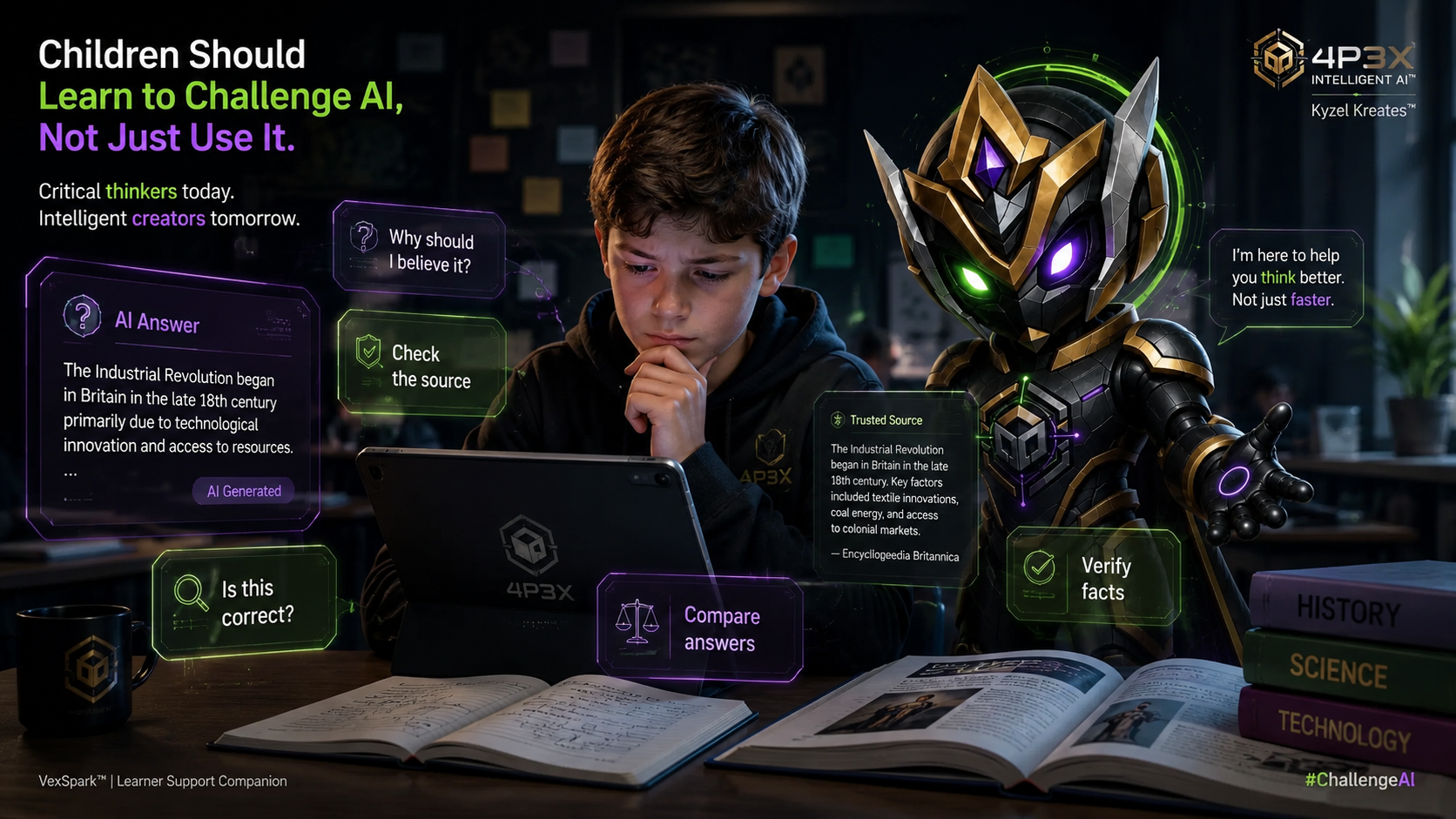
Children Should Learn to Challenge AI, Not Just Use It
As artificial intelligence becomes easier to use, one of the biggest challenges for schools may not be teaching pupils how to access it.
It may be teaching them when not to trust it.
Generative AI can produce answers that sound polished, confident and convincing. That makes it powerful, but it also creates a new kind of problem for education.
A pupil can now receive a fluent answer in seconds.
The difficult part is deciding whether that answer deserves to be believed.
That is why I think AI literacy needs to become much more than teaching children how to write prompts.
We need to teach them how to challenge the machine.
Confidence is not the same as correctness
One of the strangest characteristics of modern AI is how confidently it can be wrong.
A response can be neatly structured, grammatically perfect and completely believable while still containing errors, missing context or unsupported assumptions.
Adults can struggle with that distinction.
Children may find it even harder.
For years, digital literacy has included questions such as: who created this website? Is this source reliable? When was it published? Can the information be verified elsewhere?
AI adds another layer.
The information may not come from a visible source at all.
Instead, it arrives through a conversational interface that can feel surprisingly authoritative.
That changes the skill we need to teach.
A child should not only ask, “What does the AI say?”
They should also ask, “Why should I believe it?”
Prompting is useful, but questioning is more important
There is currently a lot of attention around teaching people how to prompt AI effectively.
That is useful.
Clear instructions generally produce better results.
But there is a danger that we accidentally teach pupils that the objective is to become better at extracting answers from a machine.
That should not be the end goal.
A much more valuable skill is being able to examine the answer afterwards.
What evidence supports this?
What might be missing?
Could there be another explanation?
Is the AI making an assumption?
What would happen if I challenged the answer?
Can I verify this using another source?
Those questions turn AI use from passive consumption into active thinking.
That is a far healthier relationship with the technology.
The best AI interaction may begin after the first answer
Imagine a pupil asks an AI system to explain why the seasons change.
The system gives an answer.
Traditionally, we might consider the interaction complete.
But educationally, that should be where the interesting part begins.
The pupil could ask the AI to explain the same concept in another way.
They could ask what the most common misconception is.
They could ask the AI to deliberately produce a wrong explanation and then identify the errors.
They could compare the response against a textbook or trusted educational source.
They could ask what evidence supports the explanation.
They could even ask the AI how confident it is and what parts of its answer should be checked independently.
Suddenly, the AI is no longer simply delivering information.
It becomes part of an exercise in reasoning.
Teach pupils to debug information
Computing already gives us a useful way to think about this.
When code does not work, we debug it.
We inspect what happened.
We test assumptions.
We isolate problems.
We compare expected behaviour with actual behaviour.
We change something and test again.
Why not teach children to apply the same mindset to information generated by AI?
An AI response can be treated almost like a piece of code that needs testing.
Where did the reasoning go wrong?
What assumption produced this conclusion?
What information appears missing?
What happens if the original question changes?
Can the answer survive scrutiny?
This approach could make AI literacy feel much more natural within computing education.
We are not telling pupils to fear the technology.
We are teaching them how to interrogate it.
AI can be used to teach disagreement
There is another opportunity here that I think is especially interesting.
AI can expose pupils to competing arguments quickly.
A system could present two different explanations of the same problem and ask the learner which is stronger.
It could generate an argument and invite the pupil to challenge it.
It could present a deliberately misleading claim and ask for the warning signs.
It could produce three answers, only one of which is well supported, and ask the learner to identify the strongest one.
Used carefully, AI could become a tool for practising disagreement.
That matters because many digital environments currently reward speed and certainty.
Critical thinking requires almost the opposite.
It requires slowing down.
It requires being comfortable saying, “I’m not sure.”
It requires checking.
It requires changing your mind when the evidence changes.
Those are skills worth teaching regardless of whether AI is involved.
Children should know that AI can be challenged
There is also something psychological about the way people interact with technology.
When a system appears sophisticated, people often assume it knows more than they do.
A child may be especially likely to accept an AI response because the technology seems intelligent.
We should actively undermine that assumption.
Pupils should know that they are allowed to tell an AI system it is wrong.
They should know they can ask it to justify an answer.
They should know they can ask for alternatives.
They should know they can refuse its suggestion.
They should know that human judgement does not disappear simply because the software sounds clever.
That principle could become increasingly important as AI systems become more conversational and persuasive.
The better the technology becomes at sounding human, the more important it becomes to remember that sounding convincing is not evidence.
Teachers remain essential
None of this reduces the importance of teachers.
If anything, it strengthens it.
A teacher can help pupils understand when an AI answer looks plausible but is misleading.
They can demonstrate good verification habits.
They can create activities where pupils compare sources.
They can show that uncertainty is not failure.
They can teach children how expert judgement develops.
AI cannot replace that relationship.
It can, however, give teachers a new set of material to work with.
A wrong AI answer can become a lesson.
A questionable claim can become a discussion.
A conflicting response can become an exercise in reasoning.
Even the mistakes can be useful if we teach pupils what to do with them.
We need to move beyond “Can children use AI?”
The debate around AI in education often begins with whether pupils should be allowed to use it.
That question matters.
But it is not enough.
Children are going to encounter AI systems in education, work, search engines, devices, customer service, entertainment and everyday life.
The more important question may be:
What kind of AI user do we want them to become?
Someone who accepts the first answer because it arrived quickly?
Or someone who pauses, questions, checks and decides for themselves?
For me, that is where AI literacy becomes real.
The future should not belong to the person who can produce the cleverest prompt.
It should belong to the person who knows what to do with the answer.
Discussion
Please login to post a comment