24 August 2026
Children Need Digital Freedom, Not Unrestricted Access

Children Need Digital Freedom, Not Unrestricted Access
The internet can be an extraordinary place for a child to learn. Within seconds, a young person can explore another country, watch a science experiment, learn how an engine works, practise another language, discover programming or find an explanation of something they were too embarrassed to ask about in class.
Artificial intelligence adds another layer to that possibility. It can explain, translate, demonstrate, answer questions and help make information more accessible.
I believe children should benefit from those technologies. But I also think we need to acknowledge something uncomfortable: giving a child unrestricted access to the internet and unrestricted access to artificial intelligence is not the same thing as giving them access to knowledge.
We would not take every book, film, stranger, advertisement, opinion and adult conversation in the world, put them into one room and tell a child to explore unsupervised.
Yet digitally, we can come surprisingly close to doing exactly that.
Access and unrestricted access are different things
The argument should not be between children having technology and children being protected from technology. Children need digital skills. They need experience with AI. They need to understand the online world they are growing up in.
Protection should not mean pretending those technologies do not exist.
But access does not have to mean unrestricted access.
Schools already understand this principle in the physical world. We provide children with age-appropriate books, equipment, environments and activities. We gradually increase independence as knowledge and judgement develop.
Digital environments deserve the same thought.
The open internet does not understand who is looking at it
A search box looks harmless. What sits behind it is considerably more complicated.
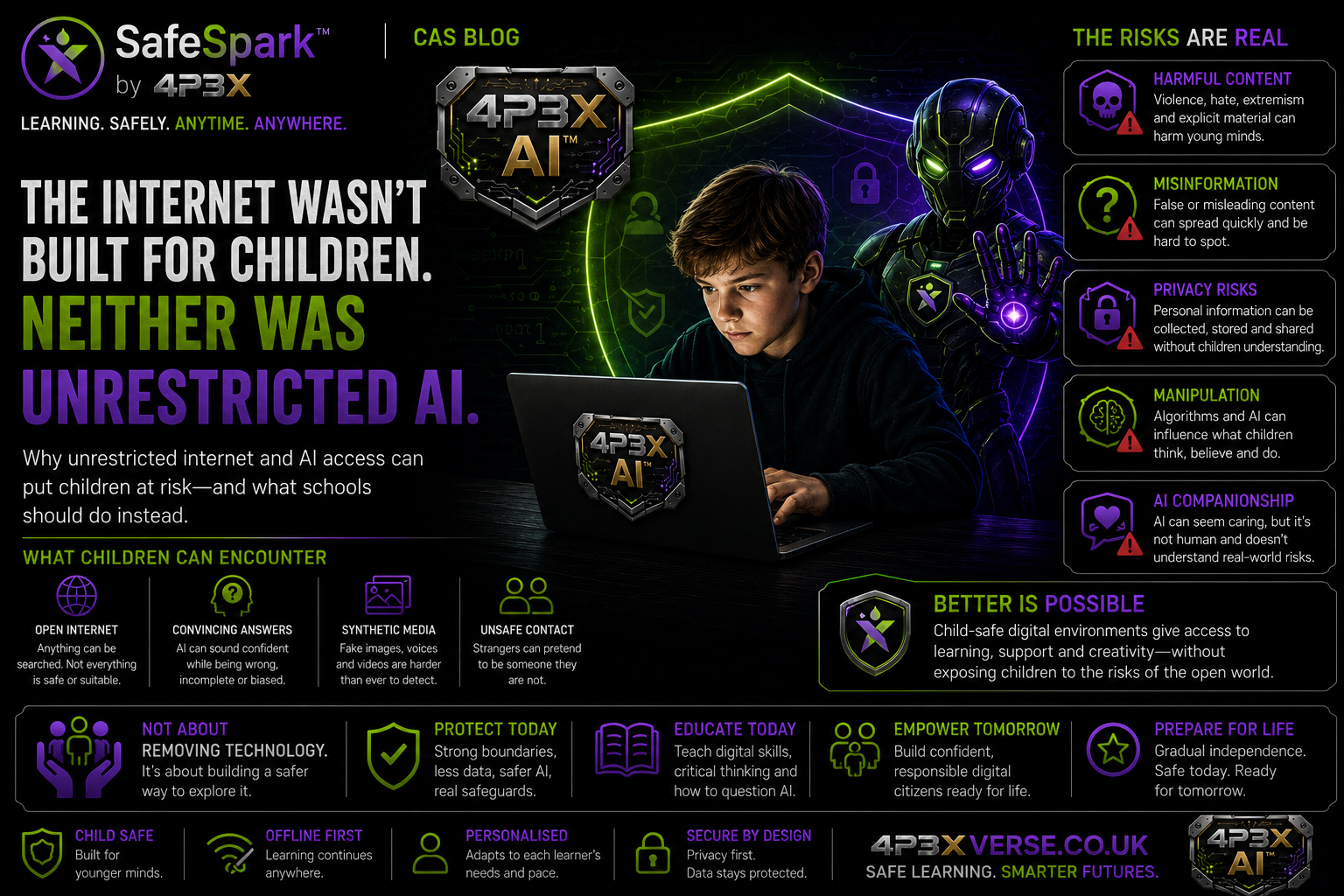
The internet contains brilliant educational resources alongside misinformation, pornography, graphic violence, scams, extremist material, bullying, manipulative advertising and communities built around harmful behaviour.
A child does not necessarily have the experience to distinguish between them.
Even when a young person is not actively searching for harmful material, recommendation systems can influence what appears next. One video leads to another. One search changes future recommendations. Curiosity can move someone surprisingly quickly from ordinary content into material they never intended to find.
The problem is therefore not simply what a child searches for. It is also what the system decides to show them.
AI changes the relationship again
Traditional internet use often involves choosing between websites, videos or search results.
Conversational AI is different. It talks back. It remembers context within a conversation. It can sound patient, knowledgeable and reassuring. Some systems are deliberately designed to feel personal.
That can make AI incredibly useful for learning, but it can also make its mistakes more persuasive.
A child may not experience an incorrect AI answer as an unreliable webpage. They may experience it as advice from something that appears to understand them.
That difference deserves serious attention.
A convincing answer can still be wrong
Generative AI can produce information that sounds completely credible while being inaccurate, incomplete or fabricated.
Adults get caught by this. Expecting children to detect it consistently would be rather optimistic.
A child asking about history might receive an invented fact. A pupil researching science could receive an oversimplified explanation. A young person asking for personal advice could receive guidance without the system understanding the circumstances surrounding them.
That is why AI literacy matters, but literacy alone should not become an excuse for poor system design.
We should teach children to question AI. We should also build AI that recognises it is interacting with children and behaves accordingly.
Privacy becomes part of the conversation
Children naturally talk. They may tell an AI about school, friendships, worries, family circumstances or things that happened during their day.
They may not understand the difference between talking to a person they trust and entering information into a digital service.
That means privacy cannot simply be buried inside terms and conditions nobody reads.
Children need clear boundaries around what information they should share, while educational systems need strong rules governing what is collected, why it is collected, where it goes and how long it remains there.
A system designed for children should collect less information, not quietly encourage them to reveal more.
Synthetic media makes trust harder
AI has also changed what children can encounter online.
Images can be fabricated. Voices can be cloned. Videos can be manipulated. People can be impersonated. False information can be generated at enormous scale.
For previous generations, “seeing is believing” was already becoming unreliable. For today’s children, it is becoming almost useless as a rule.
That creates risks ranging from relatively ordinary misinformation to bullying, impersonation, fraud and deeply abusive manipulation of photographs.
Teaching children that digital content may be synthetic is therefore becoming basic digital literacy.
AI companionship needs particular care
Some AI systems are designed to behave less like tools and more like companions. They can remember conversations, adopt personalities and respond emotionally.
For adults, that raises interesting questions. For children, it raises safeguarding ones.
A young person should understand that an AI saying “I understand you” is not experiencing understanding in the human sense.
The system does not care for them. It does not have judgement equivalent to a trusted adult. It cannot take responsibility for their welfare.
Children should have access to supportive technology without being encouraged to confuse simulation with relationship.
Restrictions should create freedom, not simply remove it
This is where I think the conversation often becomes unnecessarily polarised.
Safety controls are sometimes presented as barriers. They can actually create better environments for exploration.
A child-safe digital learning environment could provide access to approved lessons, trusted resources, age-appropriate AI assistance, creativity tools and structured research without providing an unrestricted doorway into everything else online.
Within that environment, children can experiment. They can ask questions. They can make mistakes. They can explore subjects independently. They can learn how AI works.
The boundaries make that independence safer.
A playground needs a fence not because children should never explore, but because we recognise that exploration and protection can exist together.
Digital learning deserves the same principle.
Schools should know what sits behind the AI
As AI products enter education, schools need to ask more than whether the technology is impressive.
What can pupils ask it? Can it search the unrestricted internet? What happens when a child asks an inappropriate question? Does it remember conversations? What personal information is collected? Can pupils communicate with strangers through the platform?
What happens when the AI is uncertain? Can teachers or schools control the boundaries? Does the system distinguish between an adult user and a child? What happens when its safety mechanisms fail?
Those questions are not anti-AI.
They are what responsible adoption looks like.
Children need gradually increasing digital independence
The ultimate objective should not be keeping children inside protected systems forever.
Young people eventually need to navigate the open internet and increasingly powerful AI independently. The job of education is partly to prepare them for that responsibility.
As children mature, they can learn more about searching independently, recognising manipulation, protecting personal information, challenging AI responses, checking sources and understanding recommendation systems.
Protection and education should develop together.
Eventually, the guardrails can reduce because judgement has increased.
That is very different from removing every guardrail first and hoping judgement develops afterwards.
We can build something better
The internet developed extraordinarily quickly. Child safety was not always part of its architecture from the beginning.
We have an opportunity not to repeat that mistake with artificial intelligence.
AI designed for children can have stronger boundaries than general-purpose systems. It can minimise personal data. It can avoid unrestricted communication with strangers. It can provide age-appropriate explanations.
It can recognise sensitive situations and involve appropriate human support rather than pretending it can handle everything itself. It can make uncertainty visible. It can put teachers and parents back into the decision-making structure.
Most importantly, it can give children enormous freedom to learn without pretending that freedom and unrestricted access are the same thing.
Children deserve access to the extraordinary possibilities of the internet and artificial intelligence.
They also deserve adults and technology companies willing to acknowledge the risks.
The goal should never be to build a smaller internet and lock children inside it.
The goal should be to give them a safer place from which to learn how to navigate the larger one.
Because preparing children for the digital world does not mean exposing them to all of it at once.
Discussion
Please login to post a comment