12 August 2026
AI Should Adapt to the Learner, Not the Other Way Around

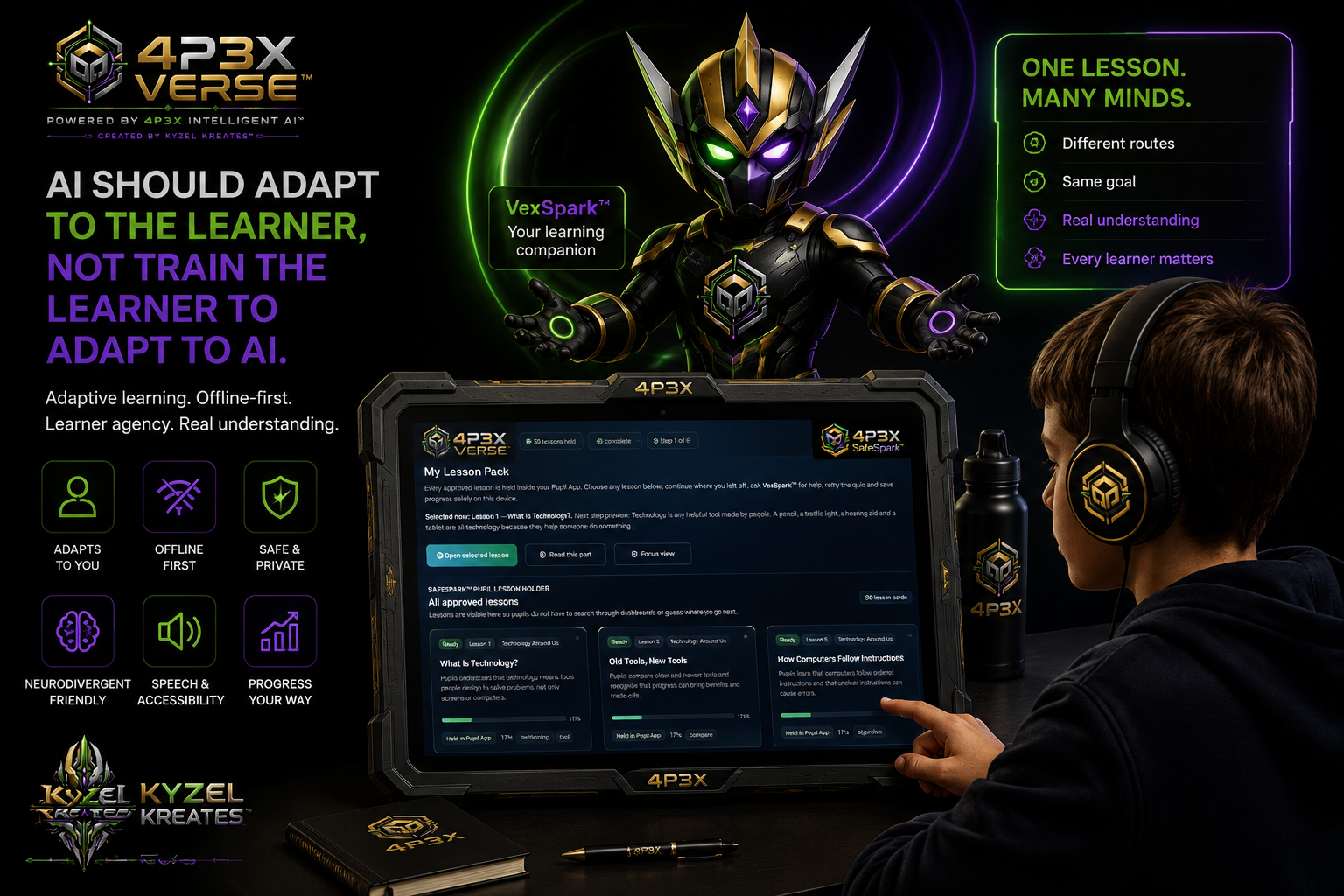
AI Should Adapt to the Learner, Not Train the Learner to Adapt to AI
For years, education has asked children to adapt themselves to the system.
Sit this way. Learn this way. Explain your answer this way. Complete the task in this order. Show your working in the format expected.
For many pupils, that works perfectly well.
For others, it does not.
I know that because I was one of them.
At school, there were times when I could arrive at the right answer but could not always explain how I had reached it in the way the teacher or system expected. Instead of the process adapting to the way I thought, the conclusion was often that I did not understand.
When that happens repeatedly, a child can begin to believe that the problem is their intelligence rather than the method being used to measure it.
That experience has stayed with me.
It also influences how I now think about artificial intelligence in education.
AI gives us a chance to change the direction of adaptation
There is a risk that we introduce AI into schools and simply recreate the same educational structures with more powerful technology.
A traditional worksheet becomes an AI worksheet.
A fixed explanation becomes an AI-generated fixed explanation.
A child still has to communicate, learn and respond in the way the system expects.
We can do better than that.
One of the most valuable possibilities presented by AI is not simply its ability to generate answers.
It is its ability to change the route to understanding.
Imagine two pupils learning exactly the same concept.
One wants a detailed written explanation.
Another needs the same idea broken into short steps.
Another understands better through examples.
Another benefits from hearing the explanation spoken aloud.
Another needs more time and repetition.
Another understands the concept immediately and needs to move forward before boredom takes over.
None of those pupils necessarily requires a different learning objective.
They may simply require a different route to reach it.
That distinction matters.
Adaptation should not mean lowering expectations.
It should mean removing unnecessary barriers between the learner and the knowledge.
One lesson, many minds
Traditional educational technology often relies on designing for an imagined average pupil.
The difficulty is that the average pupil does not really exist.
A classroom may contain children with different reading abilities, communication styles, attention patterns, confidence levels, languages, sensory needs and previous knowledge.
Teachers already adapt constantly.
They rephrase questions.
They give additional examples.
They slow down.
They speed up.
They repeat themselves.
They notice when somebody looks confused even though they have not asked for help.
Technology should support that work rather than force teachers and pupils into another rigid interface.
A genuinely adaptive learning system could allow the same lesson to be presented in several ways while preserving the same educational purpose.
A learner might choose:
- a standard explanation;
- a simpler explanation using shorter sentences;
- a deeper technical explanation;
- spoken guidance;
- examples before theory;
- theory before examples;
- visual prompts;
- additional practice;
- reduced visual clutter;
- larger text or clearer spacing;
- slower or faster progression.
The important point is that these should not automatically become labels attached to the child.
A pupil selecting a clearer explanation today does not mean a system should permanently decide they are a “low ability learner”.
Children change.
Confidence changes.
Subjects change.
Context changes.
Good adaptive technology should respond to the learner without trapping them inside its assumptions.
The learner should remain in control
There is another principle that I believe will become increasingly important as educational AI develops.
If an AI system learns about a pupil, the pupil and appropriate adults should be able to understand what it thinks it has learned.
AI memory should not become an invisible educational record that quietly follows a child around.
If a system believes a learner prefers spoken explanations, that preference should be visible and changeable.
If the learner no longer wants that support, they should be able to remove it.
If the system has misunderstood them, they should be able to correct it.
There is a substantial difference between:
“You are this type of learner.”
and:
“Would you like me to explain this another way?”
The second preserves agency.
That is where I believe adaptive AI should be heading.
Access must also mean access without perfect connectivity
There is another part of educational technology that receives less attention than it should.
The internet connection.
Much of modern educational technology assumes that every pupil has reliable broadband, continuous cloud access and an appropriate device whenever they need one.
Reality is considerably messier.
Children may share devices.
Connections fail.
Families may have limited data.
Pupils may move between school, home, libraries, support settings and other environments.
Some of the children who could benefit most from adaptive learning technology may also be those least able to rely on permanent connectivity.
That is why I believe offline-first educational technology deserves far more attention.
A learning App should, where appropriate, be capable of downloading the resources it needs and continuing to function when the connection disappears.
Lessons should still open.
Accessibility settings should still work.
Progress should still be recorded locally.
Completed work should be capable of being transferred or synchronised later when connectivity becomes available.
The internet should improve the experience.
It should not always be a requirement for the experience to exist.
AI should help children think, not simply answer
There is also a danger in focusing too heavily on what generative AI can produce.
If the main educational use of AI becomes asking a machine for an answer, we will have missed something far more interesting.
AI can be used to encourage thinking.
Instead of:
“Here is the answer.”
An educational system could respond:
“Show me how you reached that conclusion.”
“Would you like another example?”
“Can you spot what might be wrong with this explanation?”
“What evidence supports that answer?”
“Here are two possible approaches. Which one makes more sense to you?”
That turns AI from an answer machine into something closer to a thinking partner.
It also teaches an increasingly important skill: AI should be questioned.
Children growing up with generative systems need to understand that confident language does not guarantee a correct answer.
They should learn to challenge outputs, compare explanations, recognise uncertainty and decide when information needs checking elsewhere.
Critical thinking around AI may eventually become just as important as knowing how to use it.
Designing for difference benefits everybody
Accessibility is sometimes treated as a specialist feature added after the main product has been built.
I think that is the wrong way around.
Clear language benefits children with additional learning needs, but it also benefits tired children.
Spoken instructions can support pupils with reading difficulties, but they can also help somebody revising while travelling.
Reduced visual clutter may help an autistic learner or a pupil with ADHD, but it can also help anybody trying to concentrate.
Offline access can support disadvantaged families, but it also keeps learning running during an internet outage.
Designing for different ways of thinking often produces better technology for everyone.
That is not a new principle.
AI simply gives us much more powerful tools with which to apply it.
The opportunity ahead
Schools do not need AI that tells children how clever they are.
They do not need systems quietly placing pupils into permanent categories.
And they certainly do not need technology that replaces the judgement and relationships of good teachers.
What AI can do is help create more routes into the same knowledge.
It can explain again without impatience.
It can change presentation without embarrassment.
It can allow a pupil to move faster when they are ready.
It can slow down when they are not.
It can provide another way into a subject when the first explanation does not make sense.
For a child who thinks differently, that could matter enormously.
I sometimes wonder how different my own experience of education might have been if, instead of repeatedly being expected to adapt to the system, I had been given a system capable of adapting to me.
We now have the technology to start asking that question seriously.
The challenge is making sure we build it that way.
Discussion
Please login to post a comment