
08 November 2023
Let's Talk About Technology in EYFS

The statutory guidance for Early Years settings changed in September 2021 causing some furore over the removal of the ‘Technology’ heading in ‘Understanding the World’. However, it’s actually only the Technology Early Learning Goal (an end-point statement that learners are assessed against as they leave the Foundation Stage) that has been removed. If we look at what the Statutory Framework says now, we see that technology is still very much a part of what we should be teaching in the Early Years.
Understanding the world involves guiding children to make sense of their physical world and their community. The frequency and range of children’s personal experiences increases their knowledge and sense of the world around them – from visiting parks, libraries and museums to meeting important members of society such as police officers, nurses and firefighters. In addition, listening to a broad selection of stories, non-fiction, rhymes and poems will foster their understanding of our culturally, socially, technologically and ecologically diverse world. As well as building important knowledge, this extends their familiarity with words that support understanding across domains. Enriching and widening children’s vocabulary will support later reading comprehension. Educational Programme taken from DfE Statutory Framework for the Early Years Foundation Stage 2021
Our Early Years curriculum has never been limited to a focus on the Early Learning Goals (ELGs), and nor should it be. We will still be teaching children about shape and measuring, even though there is no longer a ‘Shape, Space and Measures’ ELG, and in the same way we should still be teaching and investigating technology with our children if they are to build an understanding of their technologically diverse world. Early Years practitioners have always been, and continue to be, focused on the development of the whole child and what is most important for them to thrive in the world today. I would argue that understanding the technology around them is one of the most important things learners need to grasp to thrive in today’s world.
It is unfortunate that the arguments and anxieties around young children and screen time addiction have somewhat muddied the waters when it comes to thinking about technology in the Early Years. The removal of the Technology ELG was therefore heralded by some as a valid reason to remove technology completely from their curriculum and their settings. This stance is perhaps reinforced by fact that the DfE’s non-statutory guidance ‘Development Matters’ makes no mention of technology and only mentions the word ‘computer’ once as an example of a multi-syllabic word children might learn! However, Julian Grenier’s guidance ‘Working with the revised Early Years Foundation Stage: Principles into Practice’ (2020) encourages us to “consider ICT as a way to support children’s learning and communication across all the different areas of learning”. Another widely used piece of non-statutory guidance, ‘Birth to Five Matters’ (2021) produced by the Early Years Coalition, identifies technology as an integral part of any curriculum offer:
Children require access to a range of technologies, both digital and non-digital in their early lives. Exploring with different technologies through play provides opportunities to develop skills that children will go on to develop in their lifetimes. Investigations, scientific inquiry and exploration are essential components of learning about and with technology both digitally and in the natural world. Through technology children have additional opportunities to learn across all areas in both formal and informal ways. Technologies should be seen as tools to learn both from and with, in order to integrate technology effectively within early years practice. https://www.birthto5matters.org.uk/wp-content/uploads/2021/04/Birthto5Matters-download.pdf
Therefore, rather than seeing the removal of the Technology ELG as a reason to rid ourselves of that troublesome tech that never quite works properly and always needs the batteries changing, perhaps we should see it as positive endorsement that technology, much like seasonal change in the weather, is such an integral part of our world and life today that it no longer needs a separate heading and its own goal.
Grenier (2020) encourages us to see technology as a way to support learning and communication across the whole curriculum: using it to look at snails in more detail; take photographs of things that are important; record stories and create digital art. He says technology
“is not outlined as an area of development in its own right, but it has great potential to support children’s learning when its use is carefully considered and planned. It can also be a particularly powerful tool for children with SEND.”
So now we’ve established that Technology is still evident in both the statutory and some of the non-statutory guidance, we can consider some other reasons for making sure that technology remains ever-present in our EYFS settings.
Play is arguably the most important strategy we have for supporting our young learners to make sense of their world. (It’s also perhaps one of the most misunderstood, but that’s a topic for another time.) Play helps children understand the world around them, but it’s about much more than the content and contexts we provide: it builds flexible minds and enquiring spirits. Jerome Bruner (cited in Stewart 2011) believed that developing flexible thinking was the centre of play. He saw that where children were given the opportunity to play with objects first they were more inventive and persevered longer with problem solving tasks than those who were simply taught how to use the objects and then given a problem to solve.
I saw this powerfully demonstrated by my four year old son who first played with the slo-mo app and then later used it to solve a problem. I came home from work one day to find him in fits of giggles as he watched a video of himself blowing a raspberry in slow motion on his Dad’s phone. He could barely contain himself as he showed me his tongue lolloping up and down slowly with globules of spit flying everywhere! Several weeks later, my disdain turned to amazement as my son rushed off to get his Dad’s phone to slo-mo part of the K’nex Big Ball Factory that wasn’t working properly (the ball kept bouncing out and he couldn’t work out why). By watching it back in slow motion he was able to identify the piece that was causing the issue and fix it. The point of this story is that if he hadn’t ‘wasted’ an afternoon blowing raspberries at a camera, he would never have thought to use this technology to help him solve a problem.
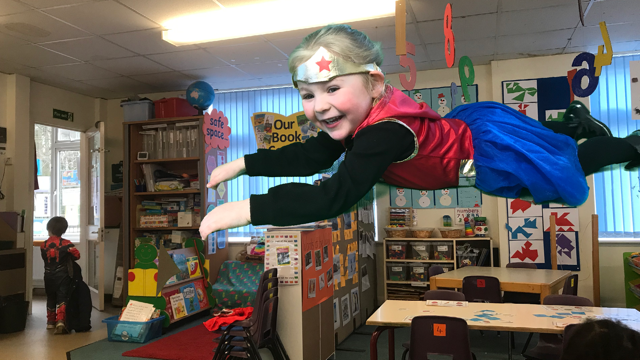
This humbling experience of my under-estimating the value of playing with random tech has driven me to play with technology even more in my classroom than I ever did before. By introducing an augmented reality horse into our classroom as part of a phonics lesson, our children were inspired to ask if we could have a tiger come too, which then led into a whole range of ‘The Tiger Who Came To Tea’ work. By making a 10 second video with a dinosaur walking through our forest school our children understood that not all the videos they watch are real or true. By using the Quivervision app to make fireworks explode in our classroom and the Chatterpix app to make a toy car talk, our children were driven to ask questions about how the technology works and went on to create their own phenomenal Chatterpix videos. (In one case, an elective mute was inspired to find his voice.) By having a range of programmable robots to play with our children develop a strong understanding of algorithms and their link to code. By using green screen technology to make our superhero children fly around the classroom, we had great fun, but I have no idea where it might lead! What I do know is that this sort of play builds children’s learning power - it deepens and consolidates learning over time. Who knows what they will do with this learning at a later date, but by exposing them to a range of technology I’m ensuring they have the potential to use it for problem solving in the future.
Technology can also encourage and support the development of specific vocabulary that gives children the ability to talk about what they observe and understand. “Knowing a word for something helps us to think about it in a more general and abstract way, rather than being tied to the particular physical object in front of us. … In this way words themselves help us to develop concepts.” (Stewart 2011) Nancy Stewart provides an excellent insight into what the Characteristics of Effective Learning look like in practice and provides compelling arguments for early years practitioners to justify the importance of what they do in her book ‘How Children Learn: The characteristics of effective early learning’ which I thoroughly recommend for anyone wanting to understand this important stage of our education system.
Education is important because it develops children’s learning power and technology can aid and enhance that learning in so many different ways. If I had a superpower it would be ‘to learn more’. The power to learn is phenomenal. It unlocks understanding, empathy, creativity, the ability to make a difference and so much more. Therefore, just as you strive to make sure your curriculum is inclusive, diverse, relevant and inspirational, I hope you will make sure the use of technology is embedded throughout.
If you’re struggling to use technology in your setting, for whatever reason (subject knowledge, confidence levels, resourcing etc) then I would encourage you to look to social media for examples of what others are doing and get involved with the Computing at School network. Barefoot resources are also a great starting point for developing those fundamental computational thinking skills that support problem solving and later learning (and they can be delivered with no technology at all). Whether you’re a Computing Subject Lead who needs support to show what you’re doing in EYFS with your subject or an EYFS practitioner who wants to enhance their provision, I would strongly recommend attending a Barefoot EYFS workshop to gain the confidence and resources to support you in this task.
We need the next generation to be able to use technology creatively and imaginatively to solve problems that we haven’t even envisaged yet. We need them to be able to enter into complex ethical and moral debates about our use of technology. We need them to be able to articulate and communicate their ideas to diverse audiences. We need them to believe and understand that they have the power to change the world. These strong beliefs and motivations need to be nurtured and embedded at the earliest possible opportunity - which I would suggest begins at birth.
References
‘Early Years Foundation Stage (EYFS) statutory framework’ DfE (2021) can be accessed here https://www.gov.uk/government/publications/early-years-foundation-stage-framework--2
‘Development Matters: Non-statutory curriculum guidance for the early years foundation stage’ DfE (revised July 2021) can be accessed here https://assets.publishing.service.gov.uk/government/uploads/system/uploads/attachment_data/file/1007446/6.7534_DfE_Development_Matters_Report_and_illustrations_web__2_.pdf
‘Birth to Five Matters: Non-statutory guidance for the early years foundation stage’ (2021) produced by the Early Years Coalition can be accessed here https://birthto5matters.org.uk/download-or-buy-a-copy/
Julian Grenier (updated July 2021) ‘Working with the revised Early Years Foundation Stage: Principles into Practice’ can be accessed here https://development-matters.org.uk/
Nancy Stewart (2011) ‘How Children Learn: The characteristics of effective early learning’
Spotted an Issue?
You Are the System Upgrade: Small Steps to Transform Computing Education

Staying Safe Online: Teaching Digital Citizenship

Code Club
#SeptemberReady
Celebrating Innovation and Community at the CAS North East Conference 2025

“The Biggest Risk Is Doing Nothing”: What Ofsted’s AI Report Means for Schools

You can call me Al...
Not just a classroom...
All aboard the Intelino Express
Using GenAI to enhance teaching and learning

Discussion
Please login to post a comment